Month: December 2023
It’s been a few years since Canada’s housing markets experienced a sense of normalcy; 2023 was no different.
The ‘Project of the Year’ is part of STOREYS annual week-long editorial series. You can find the rest of our 2023 selections here as they’re released throughout the week.
It’s been a few years since Canada’s housing markets experienced a sense of normalcy; 2023 was no different.
The Bank of Canada’s interest rate hikes and halts dictated activity throughout the year — a weak hand off from 2022 made for a slow start, but a temporary rate pause in March led to a springtime surge as buyers and sellers both falsely hoped that rate cuts were on the horizon.
However, a pair of back-to-back rate hikes in June and July quickly brought that notion, and market enthusiasm, to an end.
The overall tumultuousness of 2023 — poor market conditions, high interest rates, a lack of affordability, and reluctant buyers — led dozens of developers to delay or cancel the launch of new condominium projects.
In the past, STOREYS’ Project of the Year has featured such architectural standouts as One Delisle, bellwether market launches like 8 Elm, and perhaps the most ambitious urban development project Canada has seen this decade in The Well.
This year, however, STOREYS Project of the Year 2023 is ‘No Project.’
And no, we’re not trying to be clever, we’re simply trying to offer an accurate summation of the market that was over the past 12 months. One that saw nearly as many projects halted or cancelled as were launched. One that saw not only further interest rate hikes, but also the impact of 2022’s rising rates finally catch up – to both builders and buyers.
In a market as challenging as the one we’ve experienced throughout 2023, it didn’t feel honest to choose a Project of the Year.
A Strange, Strange Time
“We’re on track for somewhere around 13,000 or 14,000 new condo sales this year [in the Greater Toronto Area], which would put us at the lowest total since 2008,” Shaun Hildebrand, the President of Urbanation, told STOREYS. “Most developers, particularly those that have been through this type of environment before, have held back on their plans to bring new product to the market.”
“We’re in a strange, strange time. The market is in a state of limbo. Developers are waiting for either rates to come down, costs to come down, or both.”
As of November 1, some 40 projects — totalling 13,721 units — that were expected to launch in the GTA in 2023 remain on hold, according to data from Urbanation. Just under 2,500 units launched for pre-sale across the region in Q3, a 23% annual decline.
Hildebrand noted, though, that the number of reported delays doesn’t tell the whole story. A significant number of projects that did launch — 19 have been brought to market thus far in Q4 — are struggling with absorption.
It’s “very likely,” he said, that they could be pulled from the market and either relaunched at a later date or cancelled outright. In Q1 2023, the number of unsold new condo units in the GTA sat at 16,299, a 73% annual increase.
As Hildebrand explains, some developers that have launched this quarter are “testing the market” with an initial release. If it goes well, they’ll release more units. If not, they’ll pause the project until market conditions improve.
Rather than risk a faulty launch and the negative light it casts, developers that have already opted to delay are simply “reading the sentiment in the market,” said Edward Jegg, Research Manager at Altus Group, as buyers remain at bay.
“People aren’t buying, I think that is the main driver of these delays. Markets that could traditionally handle multiple projects at once, your typical multi-building developments that have done well in the past, are not right now,” Jegg told STOREYS.
“That’s generally a sign that it’s not the product, it’s the purchasers. They are not willing to purchase. [Alongside] issues with builder financing and the cost of credit, everything has come together in a negative way.”
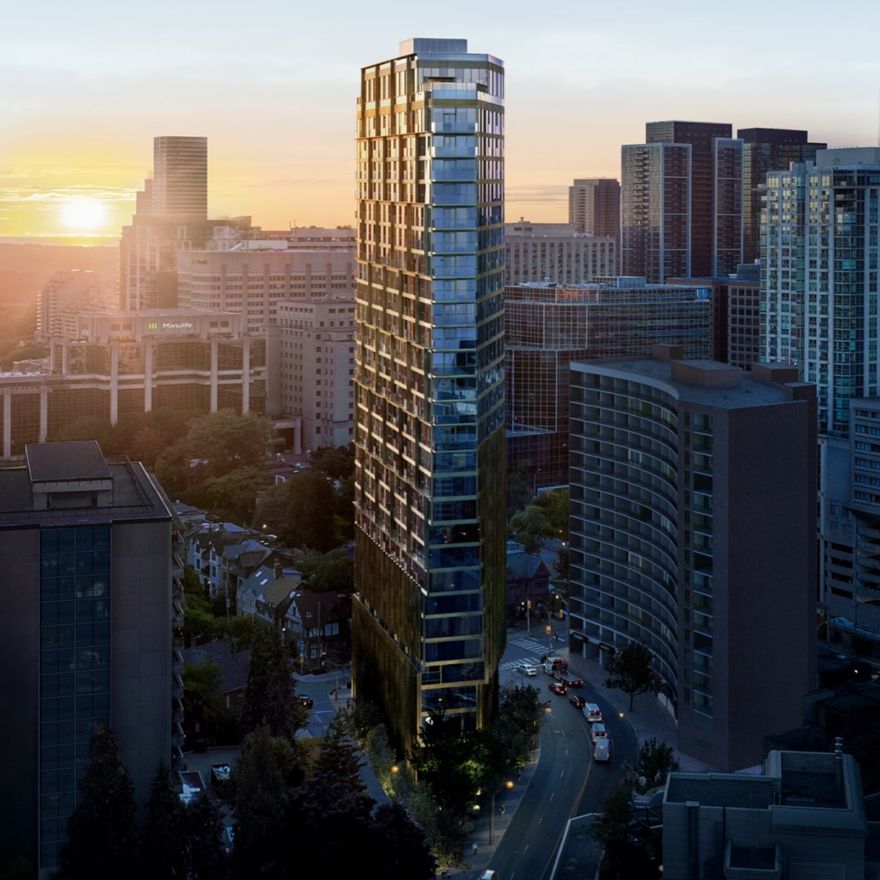
A competitive price point helped Capital Developments’s Park Road perform well in a fraught market.(Capital Developments)
On the construction side, the cost of development has skyrocketed — rising more than 40% over the last two years — as interest rates have risen at their fastest pace in history, Adrian Rocca, the CEO of Fitzrovia explained to STOREYS.
“The risk premium over the risk-free rate that investors really require to buy product has expanded. Margins have been squeezed,” Rocca said. “In the condo market, there are a lot of projects that are stuck in pre-sales at 10% to 30%. Way off the mark.”
Most developers need to see pre-sales reach about 70% before they can secure financing to actually get shovels in the ground.
In the past, pre-sales could reach 30% to 40% within three months of a project’s launch and still be able to climb to the necessary 70% within a year, Elliott Taube, a broker with Pivot Real Estate Group said.
But now, 10% to 15% of units are selling in the first few months, making it “almost impossible” to hit that higher threshold without significantly affecting initial purchasers or the bottom line of the project itself.
Persistent Pessimism
The Canadian Home Builders’ Association (CHBA)’s latest Housing Market Index reveals that an increasing number of builders have “pessimistic” views about current and future selling conditions. On the index of 100, multi-family builders’ confidence sat at 33.6 in Q3 2023, down from 41.0 in Q2.
Forty-percent of builders included in an expert panel assembled by the CHBA said that their sales traffic was down in Q3, and not showing any sign of recovery, following the summertime interest rate hikes.
With high rates simultaneously weighing on buyer demand and reducing builders’ access to capital, 65% of builders said they were being forced to build fewer units, and 37% said they’ve had to cancel projects altogether. Based on demand seen in 2023, 35% expect to start fewer homes next year.
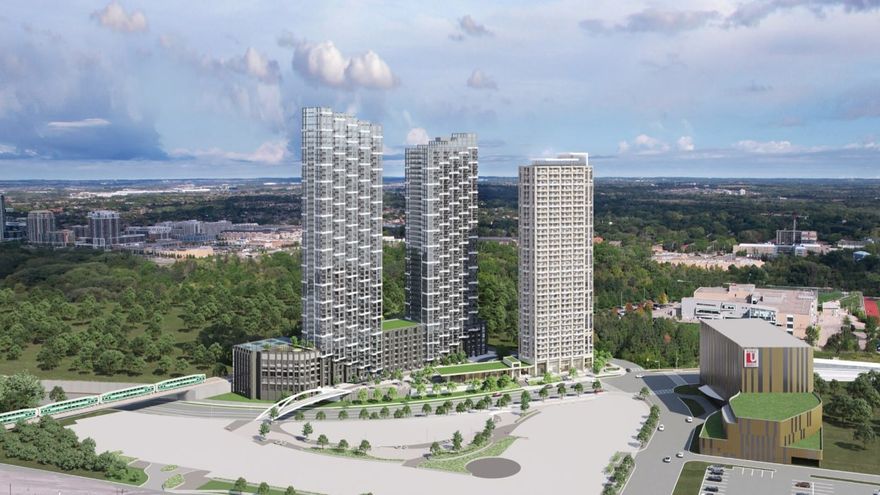
The springtime launch of Metropia’s Union City was perfectly timed to take advantage of buyer’s short-lived enthusiasm.(Metropia Developments)
Hildebrand, Jegg, Rocca, and Taube all agreed that the trend of delays and cancellations will likely persist throughout the first half of 2024 as buyers and developers wait, as they did in early 2023, for the Bank of Canada to start cutting interest rates.
“We have talked about housing supply issues for many years. We have talked about excessive taxes, fees, and levies on housing for many years. Now, in 2023, the chickens have come home to roost,” Richard Lyall, President of the Residential Construction Council of Ontario said. “The housing industry is not something where you can sort of flip a switch and then it fires back up again.”
With over 100,000 units currently under construction in the GTA, recent project delays will take a few years to fully impact supply. But when they do, the effects will be “significant,” said Urbanation’s Hildebrand.
“In order for construction in Toronto to continue growing, we need to be pretty consistent with sales of more than 25,000 units a year. So the fact that we’re only going to get maybe 13,000 units this year, that’s a pretty big deficit,” Hildebrand said.
“We’re unlikely to get 25,000 sales next year as well — I think that’s a long shot. This is certainly setting the industry up for a meaningful slowdown in construction in the years ahead.”
It’s a sentiment shared by Rocca, of Fitzrovia, who predicts that 2024 will bring a “period of volatility and rockiness.” As long as interest rates remain elevated, the market will not rebound.
Honourable Mentions
Despite the bleakness of the market, there were some projects that saw success in 2023.
Hildebrand pointed to Capital Development’s Park Road as a victory in Toronto’s downtown core, a feat he attributed to its lower price point than neighbouring competitors. Metropia’s Union City, a master-planned community in Markham, was well received during the springtime rush, Taube added.
Raglan House, from Camrost Felcorp, enjoyed successful sales after the developer offered up an enviable incentive intended to alleviate skittish buyer’s financial woes. While he stopped short of naming specific developments, Lyall noted that location was a significant contributing factor for launches that did well.
Each voice in this story, including Jegg and Rocca, mentioned CentreCourt’s Pickering City Centre. The 55-acre masterplanned community will bring 10 mixed-use towers and over 6,000 new units to Pickering’s burgeoning downtown over the next decade.
The September launch event drew 2,000 agents. The first release consists of 2,100 suits across two towers, rising 45 and 55-storeys. After just three months, they’re 95% and 50% sold out.
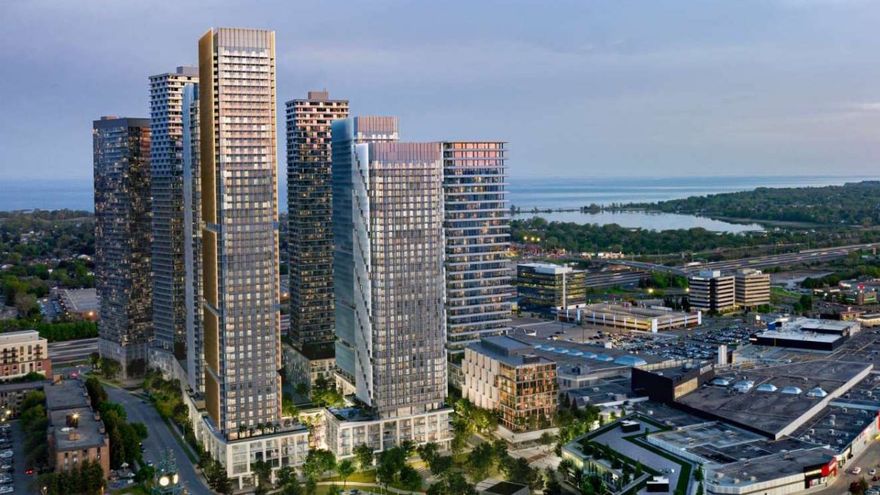
CentreCourt’s Pickering City Centre exceeded sales expectations thanks to its convenient location and low price point.(CentreCourt)
“We’d seen a lot of projects not doing well and the market was soft, so we did think about pushing the project until things were a little more receptive,” Jacob Truglia Partner and Vice President, Business Lead, at CentreCourt, told STOREYS.
“But ultimately we came to the conclusion that we don’t have a crystal ball to see what the market is going to be like. We felt that we had a competitive offering and that we were positioned to do well. And once we got into the marketing phase, it became clear to us relatively quickly that there was meaningful interest. We felt optimistic going into it, but when we saw the response, it surpassed our expectations of how much demand there would be.”
Beyond the demand, Truglia attributes the project’s success to its transit-oriented location — it’s steps from the Pickering GO Station as well as Highway 401 — its proximity to the Pickering Town Centre and a host of daily conveniences, and its low price point. CentreCourt’s in-house construction team, which allows the developer to easily manage projects with efficiency, is a contributing factor as well.
“The response had glimpses of the 2021 market. There was just a ton of excitement around the project,” Truglia said.
“Regardless of whether it was a CentreCourt project or from another developer, in today’s market it’s always great to see any project be successful, because we appreciate the challenge of operating in today’s market. Any time a project has great success on the sales side, we’re happy to see it.”
Despite buyer’s current hesitancy, the success of Pickering City Centre highlights the pent-up demand that exists within the market. When shelved projects are finally brought to market and the Bank of Canada begins cutting interest rates, buyers will be ready to pull the trigger.
Developed by CentreCourt in Toronto’s lively Entertainment District, 55 Mercer has risen to join an evermore dense cluster of downtown condominiums. Situated just west of the dual 45-storey Nobu Residences, which have been under construction concurrently, the 47-storey, Arcadis-designed residential development has now topped off about a metre shorter than these neighbouring towers.
Since our last update that covered the tower’s quick ascent on the southeast corner of Blue Jays Way and Mercer Street, a significant milestone was reached in October with the dismantling of the construction hoist, captured in the image below. This moment typically signifies both the shift from major external construction activities to completing the interior finishings, while indicating that the building’s elevators are in place to transport another necessary upwards from the interior. Also visible in the image below is the remaining facade that to be completed along Mercer Street where the hoist once stood, prepped with steel fencing in advance of the final touches.
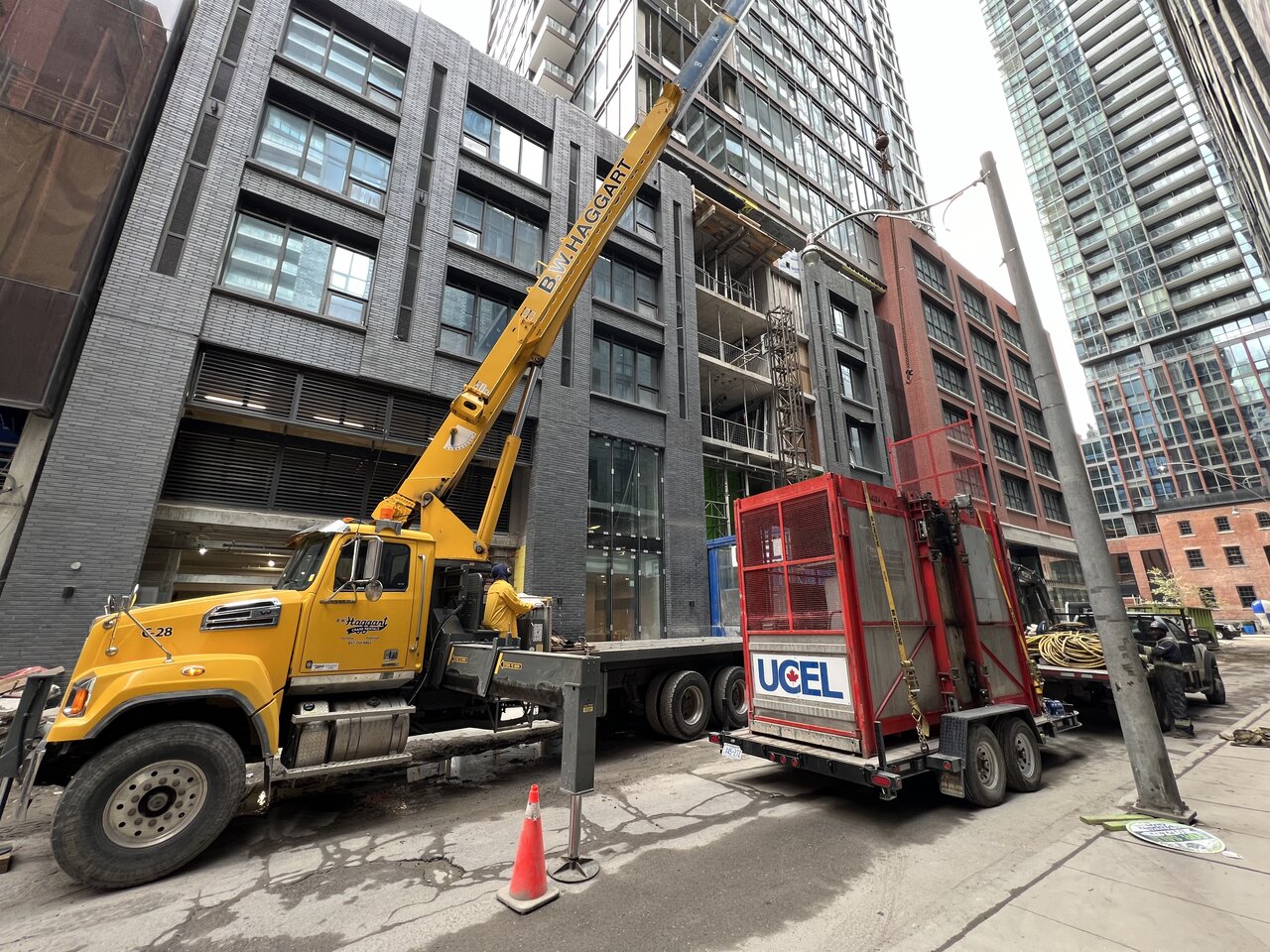 A mobile crane facilitates the dismantling of the construction hoist, image by UrbanToronto Forum contributor ProjectEnd
Closet to Blue Jays Way where the podium floors are cladding in red brick, work on the main floor’s glazing is wrapping up, with workers completing the installation of the final glass panels around the residential lobby entrance using a boom lift. To the right, large-glazed storefronts offer expansive views into the commercial space, still bare concrete inside.
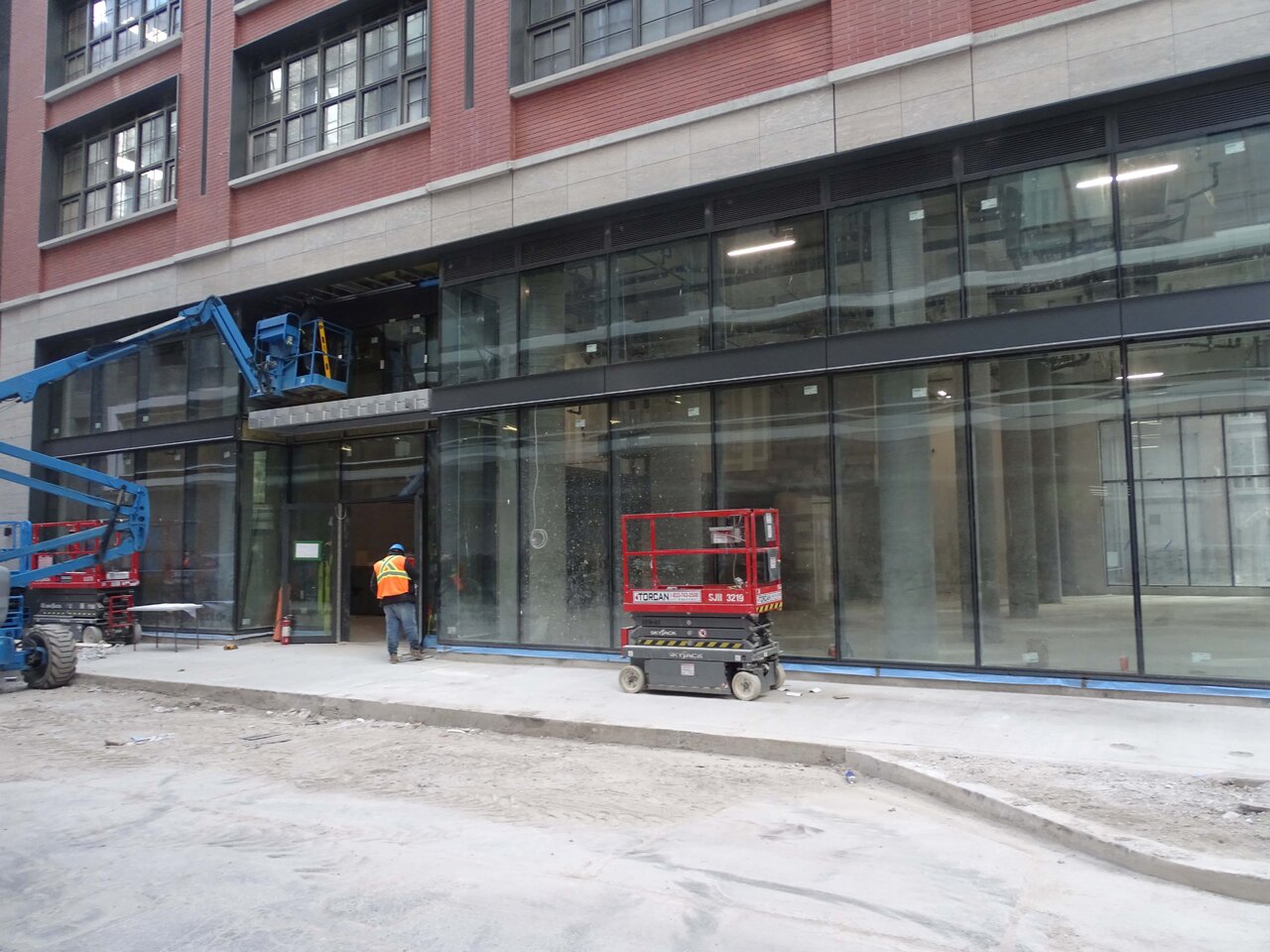 The podium glazing, image by UrbanToronto Forum contributor Northern Light
Right at the corner of Blue Jays Way and Mercer, the podium’s detailed design — divided light windows punched into the brick and stone cladding in a formal grid — blends 55 Mercer’s new structure with the district’s heritage warehouse aesthetic.
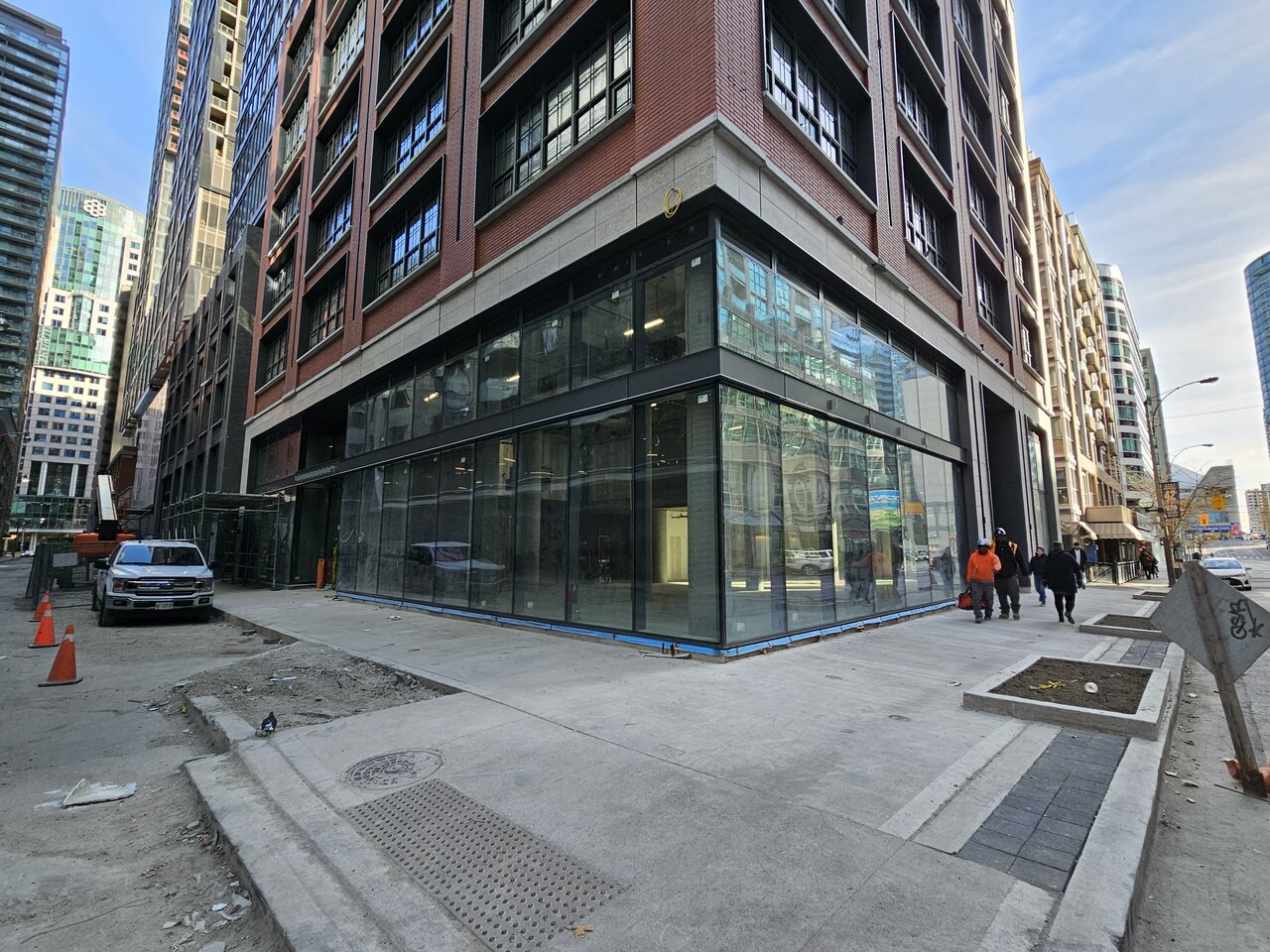 The podium with fencing and scaffolding removed, image by UrbanToronto Forum contributor AHK
Looking upwards from street level along Blue Jays Way, the tower is significantly set back from the podium levels, while its cladding moves more towards — but not entirely — to the all-glass facades we see so often. Here, metal panels and louvres interrupt the glass at every floor slab, most of it coloured to sync with the podium cladding below. The southeast and northwest corners of the tower, however, provide contrast through white frames that add a modern twist to those parts of the building’s facades, while also giving the tower a less monolithic look.
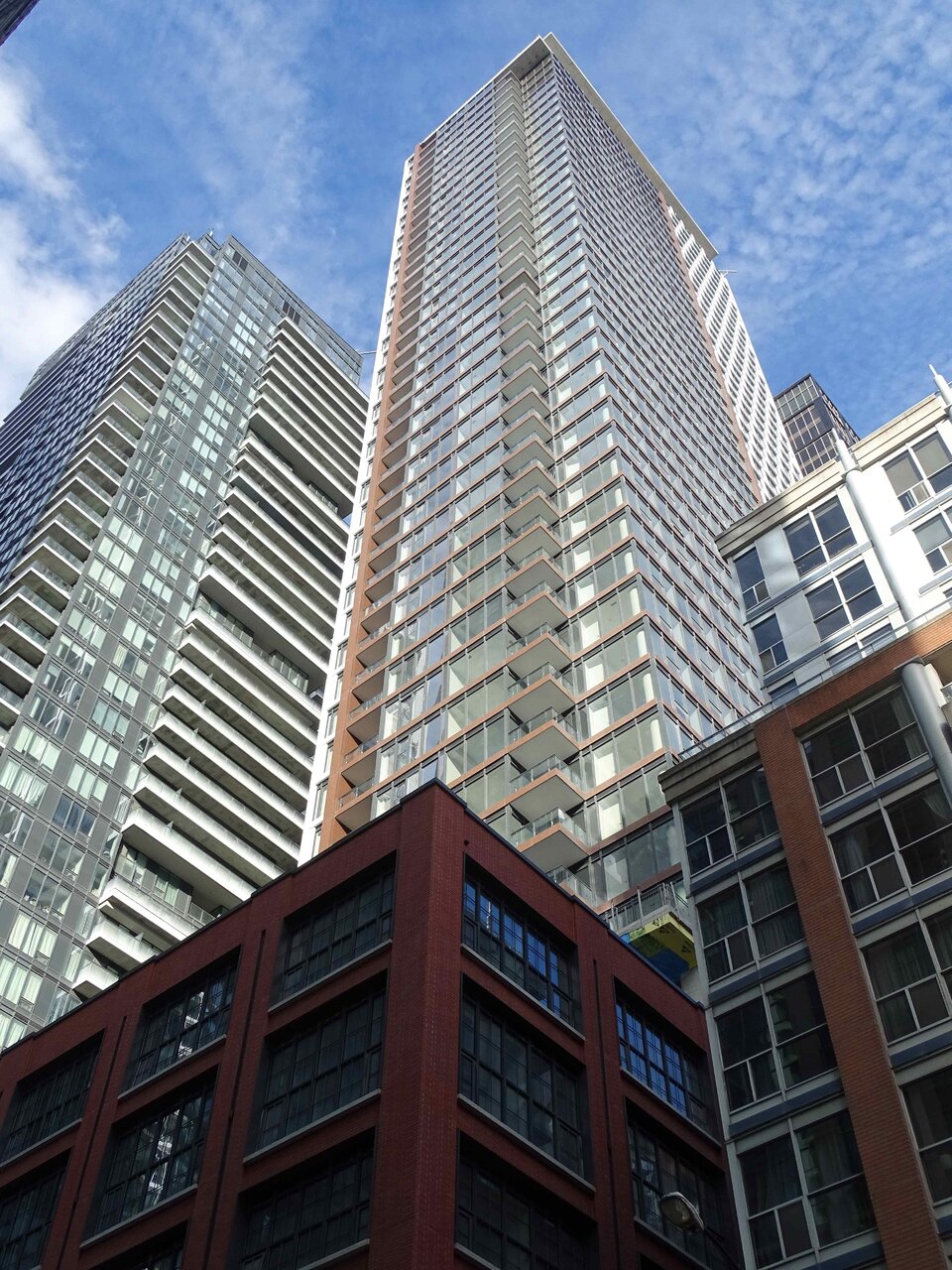 Looking east from Blue Jays Way to the tower, image by UrbanToronto Forum contributor Northern Light
Stepping back, the full height of 55 Mercer Condos is captured, showcasing the integration of the more modern glass tower with the heritage-inspired podium. With both the hoist and tower crane taken down, the completed facade of the podium and the nearly fully installed windows show a building poised to take on its final, soon-to-be-lived-in look.
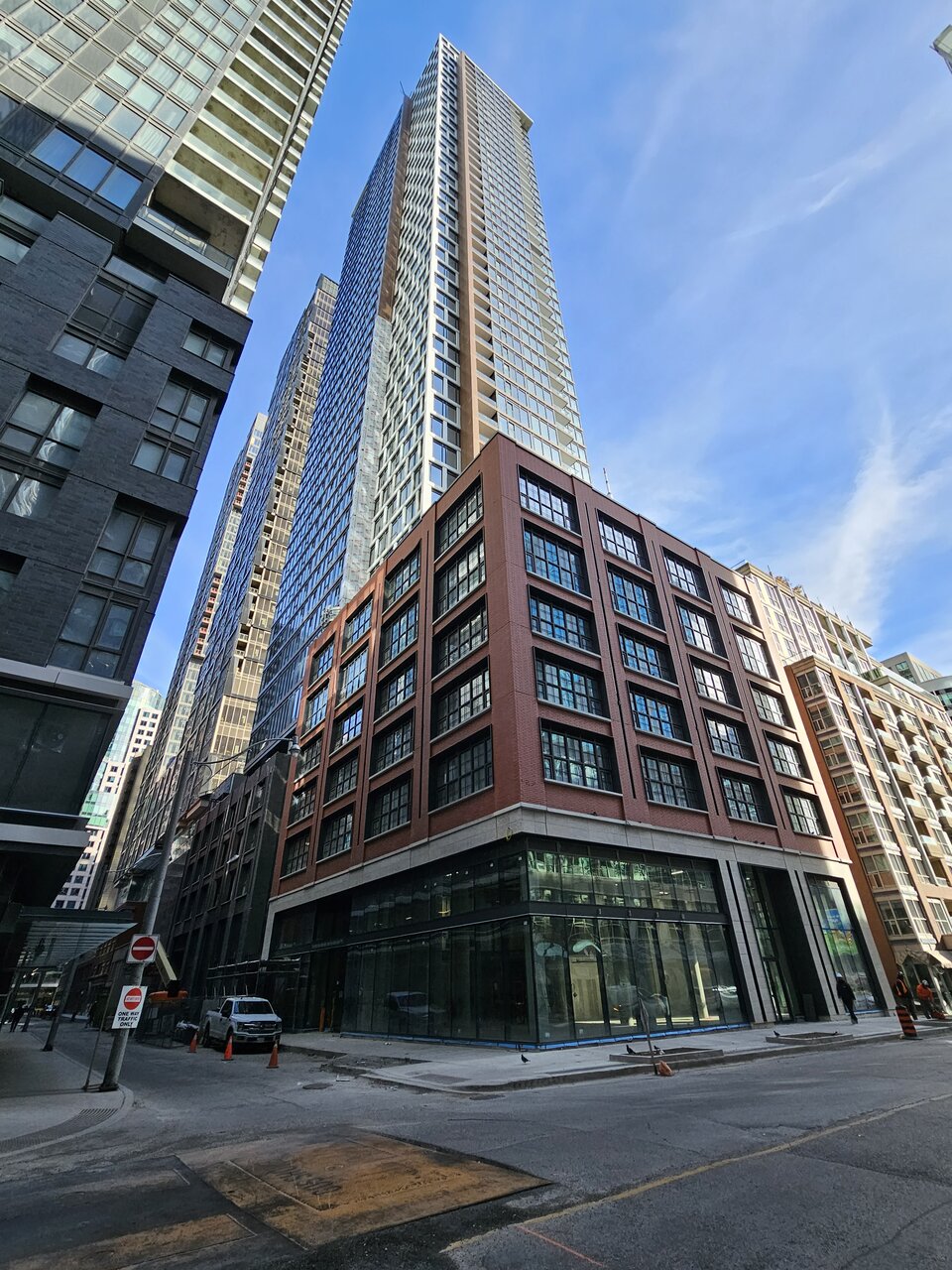 The podium and tower of 55 Mercer, image by UrbanToronto Forum contributor AHK
Standing at a final height of 155.5m and set to deliver 543 new residential units, 55 Mercer Condos is heading towards the finish line, to join the ranks of may other surrounding towers in the Entertainment District.